
Marion County Projected Release Dates
A projected release date is an official estimate for a sentenced person based on the sentence data, applicable law, credit assumptions, and agency records then in effect. It is not the same as parole eligibility, supervised-reentry eligibility, or actual release. SCDC’s current inmate detail uses the exact field label PROJECTED RELEASE DATE. It separately displays PROJECTED PAROLE ELIGIBILITY and may display SUP. REENTRY ELIGIBILITY. A field can contain a date or “NOT ELIGIBLE.”
Those milestones answer different questions. Parole eligibility means a person may become eligible for Board consideration. It does not mean parole was granted. Supervised-reentry eligibility is not a discharge date. The projected release field estimates the end of the incarceration stage under current data. After SCDC custody ends, the separate Released Inmate Search supplies the actual release date and release type.
A person awaiting trial at Marion County Detention Center has no computed prison release date. The next event can depend on bond, dismissal, plea, sentence, time served, another warrant, or transfer. Even a favorable court order may not produce an instant exit because staff must receive the papers, run final checks, and complete the facility process.
Find Marion County Projected Release Dates
Identify the last custodian before searching. For a person sentenced to SCDC, use the current Incarcerated Inmate Search and open the detail record. That search accepts an SCDC ID, SID, first name, or last name and offers phonetic matching. The public record covers people incarcerated in SCDC as of midnight the prior day. It does not cover released SCDC inmates, county-jail sentences, parole, probation, or other community supervision.
For a county sentence, ask the Marion County Detention Center or the separate Prison Camp records custodian for the commitment, time-served calculation, and recorded release or transfer entry. Compare those records with the sentencing order from the correct Marion court. For a pretrial case, check bond and docket action instead of searching for a date that has not been set.
- Confirm whether the person is in the Marion jail, Prison Camp, SCDC, federal custody, or another system.
- For current SCDC custody, search by SCDC ID or SID when possible and open the inmate detail.
- Read PROJECTED RELEASE DATE separately from parole and supervised-reentry eligibility.
- For a county sentence, request the sentence, jail-credit calculation, and facility release or transfer record.
- Check the court for amendments, concurrent or consecutive terms, bond, and other orders.
- Verify a time-sensitive state date with SCDC Inmate Records at 803-896-8531.
The official SCDC current offender search shown below is the state-custody starting point.
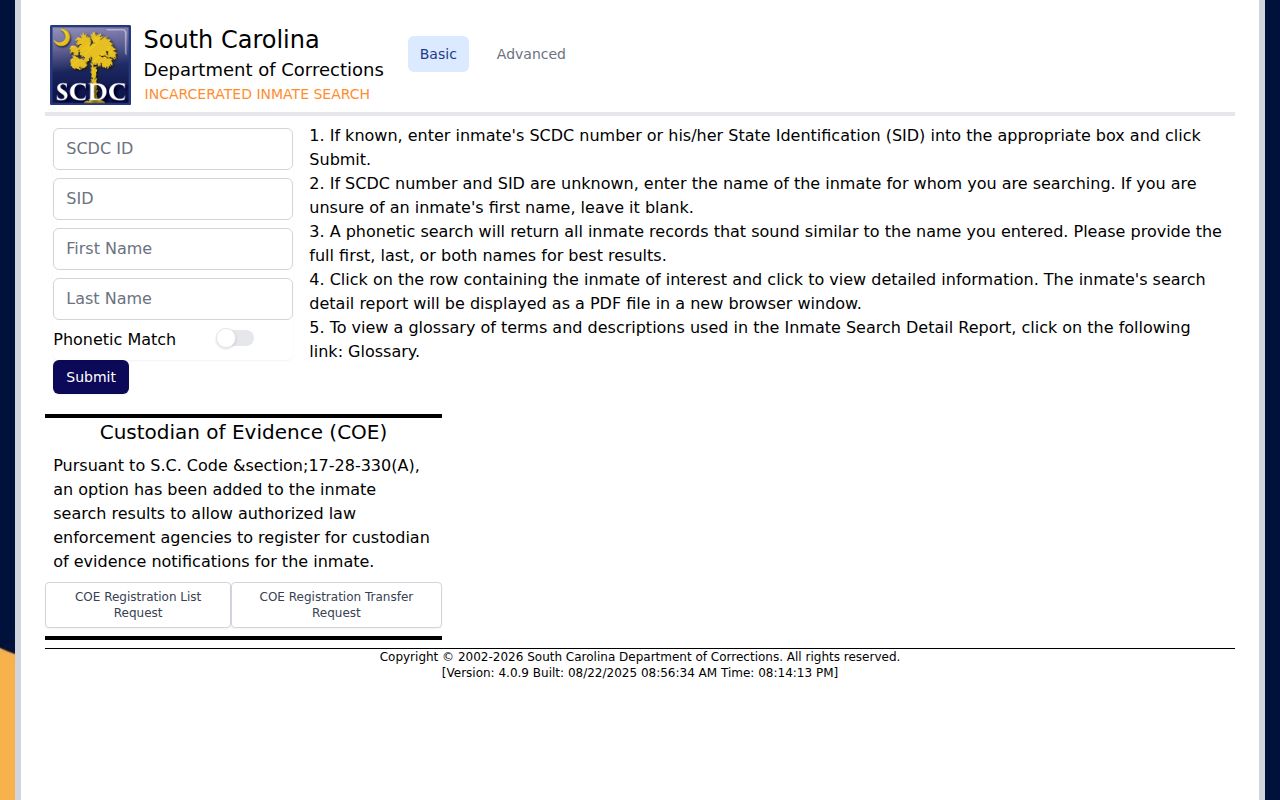
Its scope is current SCDC incarceration, so a Marion County jail detainee or an already released person needs a different record.
Note: SCDC current-search data reflects the prior midnight and cannot answer a same-hour Marion County jail release question.
Marion County Sentence Credit Rules
South Carolina Code Title 24, Chapter 13 controls the main sentence-credit framework. Section 24-13-100 defines a “no-parole offense” as a Class A, B, or C felony, or an exempt offense punishable by a maximum term of 20 years or more. Under §24-13-150(A), a person convicted of such an offense and sentenced to SCDC generally cannot receive early release, discharge, or the specified community supervision until serving at least 85 percent of the actual prison term, excluding the suspended part. Credits cannot reduce that statutory floor.
The 85 percent rule does not apply to every person. Classification, offense, sentence date, mandatory minimum, and other statutory limits matter. A plain claim that everyone serves 85 percent is wrong. Other rules can require more time. The exact current code and sentence record must be applied to the person’s case.
Section 24-13-210 provides good-conduct credit. A qualifying SCDC inmate without a no-parole offense may earn 20 days for each month served. A qualifying no-parole inmate may earn three days per month, subject to life and mandatory-30-year exclusions and the minimum-service floor. A locally sentenced detention or public-works prisoner may earn one day for each two days served. The responsible authority can forfeit credit for rule violations.
Section 24-13-230 concerns productive-duty and education credits. For a non-no-parole SCDC sentence, the director may award up to one day per two qualifying days, with combined work and education credits capped at 180 days each year. For a no-parole sentence, the statute provides six days per month, capped at 72 annually, without crossing the required minimum. Local officials must publish a local productive-duty rate from zero to one day per two days worked. Educational credit is unavailable for a violent crime as defined by state law.
Sentence time is computed on a 365-day year under §24-13-175. Section 24-13-125 also restricts work release for many no-parole inmates before 80 percent of the actual term, subject to its specific text. These provisions affect separate parts of custody. They should not be merged into one percentage or treated as a guaranteed release date.
Marion County Release Date Calculator
SCDC publishes a separate educational calculator. The agency calls its result an “earliest possible case scenario” based on the information entered and an assumption that all possible good-time and earned-work credits will be obtained. It cannot calculate the release date of an inmate who has already been sentenced, and it should not be used for a Youthful Offender Act sentence. Those limits make it unsuitable as proof of a real person’s date.
For an existing SCDC inmate, read the official current detail and contact Inmate Records. The calculator is useful for learning how statutory inputs can affect a hypothetical sentence. Its result can be wrong if the offense class, sentence structure, start date, credit, or other input is wrong. Future credits may never be earned or may later be forfeited.
The SCDC release-date calculator and disclaimer are captured below.
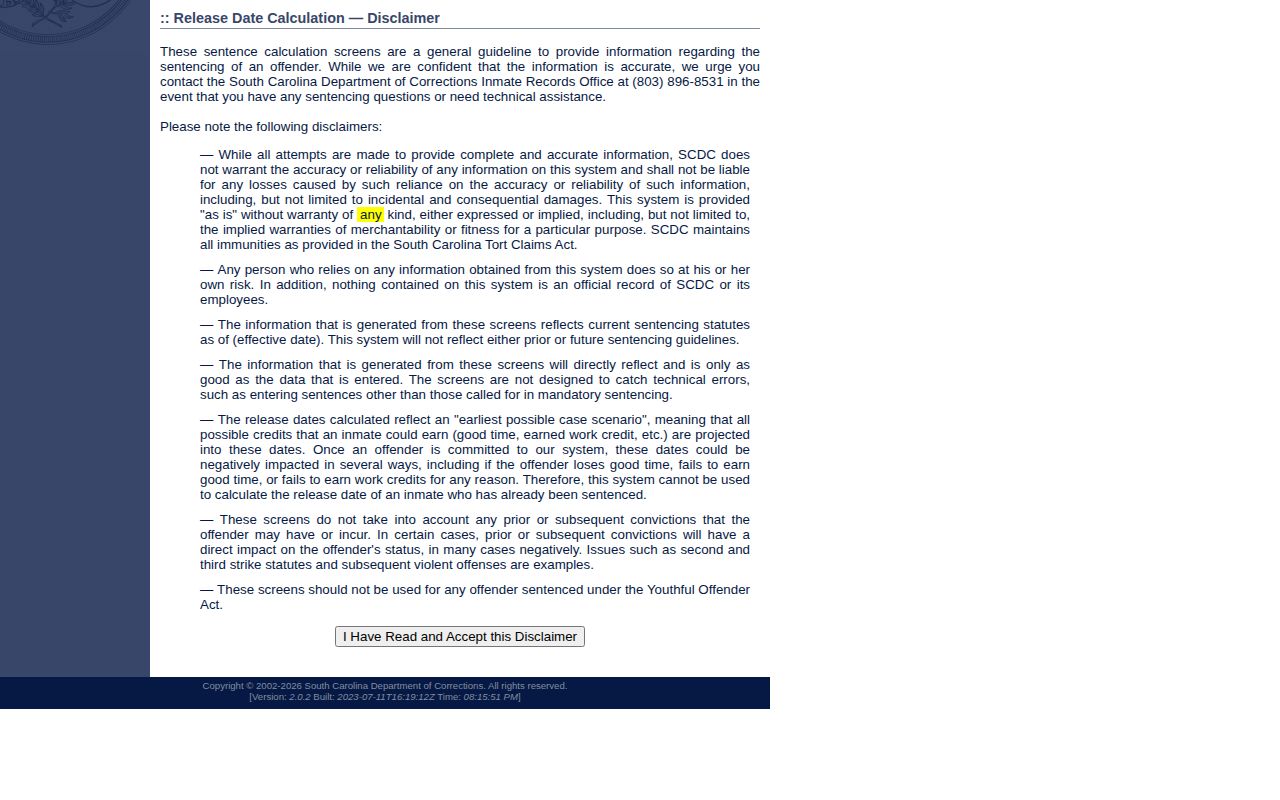
The official warning keeps an educational estimate separate from the PROJECTED RELEASE DATE held in a current inmate record.
Why Marion County Release Dates Change
A projected date moves when an input or legal condition changes. Some changes shorten the estimate. Others extend it or prevent the expected departure. A court can amend a sentence. SCDC can correct jail credit or sentence data. Future good time can be earned, lost, or forfeited. A second sentence may run at the same time as the first, called concurrent, or start after it, called consecutive.
| Factor | Possible effect | Best record |
|---|---|---|
| Good-conduct credit | May move a qualifying estimate earlier when earned | SCDC or responsible local calculation |
| Discipline or forfeiture | May remove projected credit and move the date later | Custodian’s sentence-credit record |
| Jail credit | Correct credit for prior custody can change time remaining | Judgment and agency sentence record |
| Court amendment | Can change the term, suspended part, or sentence structure | Filed court order |
| Concurrent or consecutive terms | Changes whether terms overlap or run one after another | Judgment and SCDC calculation |
| Hold or detainer | May end one custody while another agency takes the person | Release or transfer entry naming the custodian |
| Parole action | A grant can create a conditional release path; eligibility or a hearing alone cannot | Board result, then SCDC release record |
A detainer is a request or notice that another authority may take custody. Marion’s booking system records holds, warrants, detainers, and extradition information. Payment or a favorable order in one case may not lead to departure if another valid hold exists. The release authority, type, and destination are more reliable than a roster disappearance.
Note: A changed projected date can reflect lawful credit, corrected data, a court order, or another custody claim rather than an error.
Marion County Actual Release Search
South Carolina has an unusual and useful second SCDC tool: the Released Inmate Search. This is the distinctive alternative to the current-only locator. It requires the beginning and end of a release-date range and a county choice. MARION is available as county value 34. An optional sex-offender indicator can narrow the query. Results paginate, and an Export control exposes more fields.
Visible results include SCDC ID, name, sex, race, age, sex-offender indicator, release date, release type, and county. Export also includes SID, victim indicator, detainer indicator, and the most serious offense. There is no photograph field. Most important, this is a state-prison release dataset. A Marion county filter does not turn it into the Marion County Detention Center release ledger.
This separation solves two different questions. The current SCDC detail supplies PROJECTED RELEASE DATE while the person is still incarcerated. The Released Inmate Search supplies the later actual date and type after SCDC custody ends. A county detainee who never entered SCDC needs the county booking and release record. A person transferred from Marion into SCDC remains incarcerated during that transition.
Use the actual release tool to close the loop. A release type of parole, probation, or community supervision points to SCDPPPS as the next verification layer. “Released” from SCDC means SCDC custody ended. It does not prove the whole sentence was discharged or rule out another lawful custodian.
Confirm Marion County Release Dates
For SCDC custody, compare the current projected date with Inmate Records, then use the Released Inmate Search after the event. For a Marion county sentence, compare the court judgment, facility time calculation, and booking or institutional release record. The Detention Center phone is 843-423-0121. The separate Prison Camp has no verified public online release feed, so County Administration should identify the current records custodian when needed.
SC VINE can send a notice of release or transfer, but the alert must be read with the supplying agency. Registration does not automatically follow an interagency transfer. The Marion County VINE inmate check explains the search, PIN, contact channels, and re-registration step. Use the alert to prompt a source check, not as a substitute for the release record.
A physical exit can lag behind a court order. Marion County says staff must receive valid papers, run final warrant checks, and complete release processing. Outside-court orders return to the jail, and some General Sessions paperwork arrives late. A date on a docket therefore may explain the legal authority without proving the door-release time.
Note: The strongest result pairs the agency’s actual release entry with the court, supervision, or next-custodian record that explains what followed.