
Marion County Parole and Probation
Parole and probation both place a person in the community under legal supervision, but they begin in different ways. Parole is a conditional release from an eligible state prison sentence after action by the South Carolina Board of Paroles and Pardons. Probation is a court-ordered sentence, often used in place of all or part of a jail or prison term. Statutory community supervision may follow prison for certain sentences. Supervised reentry and supervised furlough are other named SCDPPPS categories. None should be treated as the same event as release from the Marion County Detention Center.
The South Carolina Department of Probation, Parole and Pardon Services, or SCDPPPS, manages these community statuses. SCDC manages incarceration. A released state prisoner may appear in the SCDC Released Inmate Search with a release type such as parole, probation, or community supervision, then appear in SCDPPPS records while supervision remains active. A person who posted bond at the county jail may be out of custody without being on probation. The court docket and the correct agency record establish the difference.
| Point | Parole | Probation |
|---|---|---|
| How it begins | Board grants conditional release from an eligible state prison sentence | Court orders community supervision as part of a sentence |
| Main source | Board decision, SCDC release record, then SCDPPPS | Sentencing order, court docket, then SCDPPPS |
| Custody meaning | Outside prison, still serving a supervised part of the sentence | Outside jail or prison unless a later violation leads to custody |
| How it ends | Completion, discharge, revocation, or other lawful Board action | Completion, discharge, court action, or revocation |
- Parole
- Conditional community release before an eligible prison sentence fully expires.
- Probation
- Court-ordered supervision in the community, sometimes linked to a suspended term.
- Discharge
- The formal end of the applicable supervision obligation.
- Absconder
- A person alleged to have stopped reporting or left supervision without approval.
Verify Marion County Post-Release Supervision
The official SCDPPPS offender search is the first online check for active supervision. It accepts first name, last name, SID, county, and birth year in the valid combinations shown by the form. Use a SID when available because names and birth years can match more than one person. Set the county to Marion when the current supervising office is known to be local. The results reflect the previous day, so they are not a same-hour status report.
A blank result has limits. SCDPPPS warns that someone no longer supervised may not appear. A spelling variant, completed term, recent transfer, or data timing can also explain a missing record. The Marion County office is the right same-day channel for active supervision questions. A court sentencing order can confirm probation, while the Board result and SCDC release entry can confirm the path into parole.
- Gather the full name, birth year, and SID or SCDC number if known.
- Run the SCDPPPS search with a valid field combination and Marion County as the county filter when appropriate.
- Read the supervision status and office information, keeping the prior-day update limit in mind.
- For probation, compare the result with the judgment or sentencing order in the Marion court record.
- For parole, check the Board schedule or result and the separate SCDC release date and type.
- Call the Marion office for a current status when the public result is missing, unclear, or time-sensitive.
The official search interface is visible in the SCDPPPS source captured below.
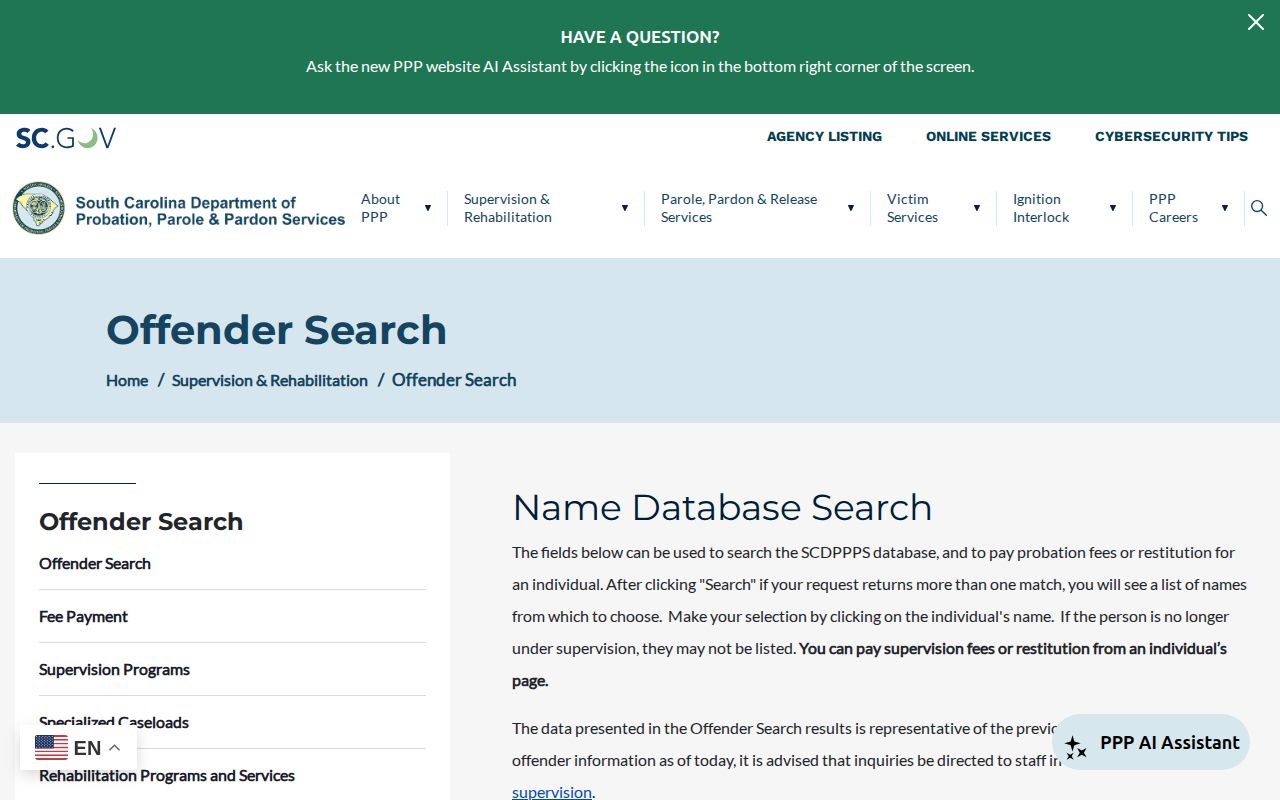
Its field choices show why an SID or a careful name-and-birth-year match is stronger than a broad name search.
Note: An SCDPPPS result reflects the prior day, so the Marion County office remains the best source for a same-day change.
Marion County Supervision Office
SCDPPPS publishes a dedicated Marion County office page and a date-stamped local caseload snapshot. On July 24, 2026, the agency listed 121 probation cases, 11 parole cases, 8 community supervision cases, 6 supervised reentry cases, 6 Jessie’s Law tracking cases, and no supervised furlough cases. Those counts are not release totals. They show active categories on one date and will change as cases begin, end, or move.
Agent in Charge Rhonda Elliott was named on that snapshot. The office can address current reporting location and supervision-status questions within the limits of public information. It is not the records office for a Marion jail release, and it cannot turn a parole eligibility date into a Board grant. Keep the person’s SID, full name, and any court or SCDC record at hand before calling.
SCDPPPS Marion County Office1305 North Main Street
Marion, SC 29571
Mailing: P.O. Box 546
Phone: 843-423-2666
Fax: 843-423-1555
Official Marion County office page
Marion County Parole Decision Records
A projected parole eligibility date is not a release order. The seven-member South Carolina Board of Paroles and Pardons may grant or deny parole, revoke or modify parole, and rehear matters. Its 2026 calendar lists Full Board, Single Panel, pardon, and administrative dates by month. The schedule varies. There is no sound basis for assuming that every Marion case is heard on one fixed day.
The parole hearing and result search accepts a name, SCDC number, and hearing month in the combinations the interface allows. SCDPPPS says schedules become available about 30 days before a hearing and advises periodic checks for rescheduling or delayed results. Official outcome terms include granted and denied. If denied, another hearing may occur in one or two years, based on the offense date and classification. A grant still is not the physical exit time. Verify the later event through SCDC’s actual release record and SCDPPPS supervision.
The Board conducts hearings by videoconference with the incarcerated person. General eligibility appears in South Carolina Code §24-21-610, but the correct offense, classification, mandatory minimum, and date of law control. Good-behavior deductions do not reduce parole eligibility under that framework. When a schedule or result needs prompt clarification, the Board’s immediate-assistance number is 803-734-9220.
Marion County Supervision Status Changes
Conditions are the rules attached to community supervision. They can include reporting, approved residence or travel, payment duties ordered in the case, treatment, and compliance with the law. The exact terms come from the court, Board, and supervising agency, not from a generic list. A violation allegation can prompt agency review, a warrant, or a revocation process. Revocation means lawful cancellation of supervision that may lead to custody after required proceedings.
SCDPPPS maintains an official Most Wanted page for alleged absconders and provides a hotline at 1-888-761-6175. A person on that page is a suspect and is presumed innocent unless proved guilty. The listing signals an enforcement issue. It does not confirm that the person has been arrested or returned to the Marion County Detention Center. Confirm a later arrest with the new custodian and court record.
Most Wanted is not a full list of every missed report or warrant. It is a selected enforcement publication. Search the responsible court and new custodian when an arrest is alleged, and use the local supervision office for the active case status that it may lawfully provide. If SC VINE sends a custody change, note the named agency. That agency, not the absconder page, can confirm whether confinement began.
SC VINE can add notification and status information because county detention centers, SCDC, and SCDPPPS supply data to the service. Yet VINE is not a certified supervision history. It may lag, and registration does not automatically follow a transfer between the county jail and SCDC. Use it as a notice channel, then verify the event with the agency responsible for the person.
Note: “Out of custody” and “off supervision” are separate facts, each requiring a record from the agency that controls that stage.
Marion County Supervision Discharge
Supervision ends through a formal event, not merely because a name disappears from an online search. A discharge documents completion of the applicable supervision term. A court order may control probation. SCDPPPS and Board records govern the state supervision path. Section 24-13-210(E) also matters for some state sentences: release after credits may count as service of the prison portion, but a sentence subject to required community supervision is not fully discharged until that supervision ends.
For a past Marion County case, collect the SCDC release date and type, the SCDPPPS status or discharge information that is publicly available, and the relevant court or Board order. Each record answers a different question. The SCDC current inmate search does not include parole, probation, or other community supervision. The SCDC Released Inmate Search records the prison exit but is not a complete supervision ledger. The broader Marion County released inmate search path explains how county, court, and state custody records fit together.
If a web result is gone, call the Marion office and request the source record from the proper custodian. Ask for an existing document rather than a new explanation. State public-record law permits access to many agency records but still allows exemptions, redactions, and sealing rules. Those limits are why a verified discharge should rest on the responsible agency’s record.
Keep the terms precise when saving the result. Completion of incarceration is not always completion of the sentence. A person may leave SCDC into parole or mandatory community supervision, remain accountable to SCDPPPS, and receive a later discharge. Recording each date with its agency prevents the prison release date from being mistaken for the final end of supervision.